

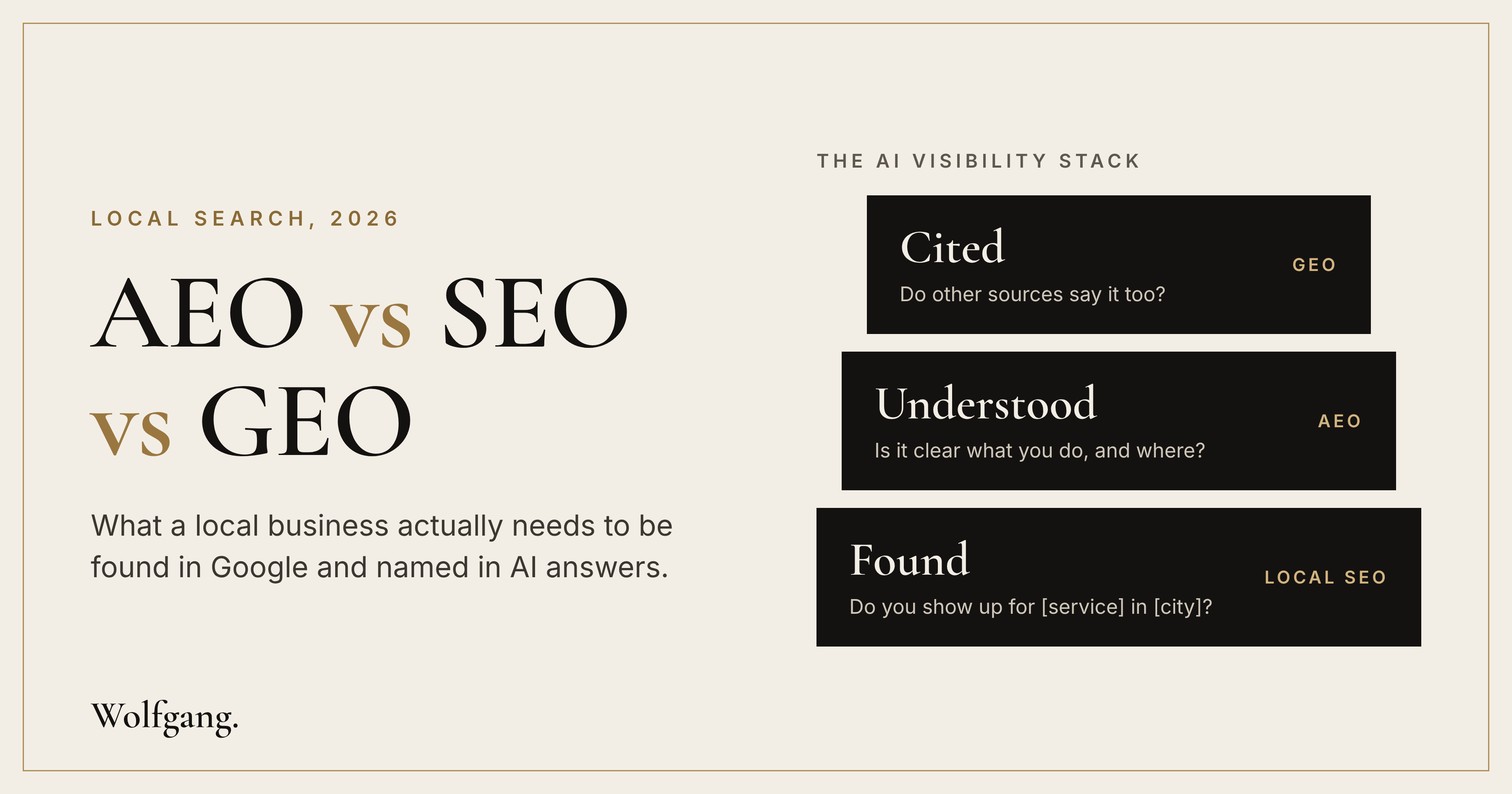
AEO vs SEO vs GEO, in plain terms: SEO gets a local business ranked in Google and the map pack. AEO gets it chosen as the answer. GEO gets it named inside AI tools such as ChatGPT and Google AI Mode. All three run on one foundation: a complete Business Profile, steady reviews, consistent facts and a clear website.
Key takeaways
SEO, AEO and GEO are three views of the same work, not three separate budgets.
Google says no special optimization is needed to appear in AI Overviews or AI Mode beyond normal search eligibility.
For a local business, the Google Business Profile and reviews feed all three.
The AI Visibility Stack: be Found, be Understood, be Cited. In that order.
You can check where you stand today by asking Google and ChatGPT a few plain questions.
What is the difference between SEO, AEO and GEO?
The difference is where you show up. SEO puts you in the search results and the map pack, AEO makes you the single answer to a question, and GEO gets you named inside an AI-written response.
For years, local search had one goal: rank in Google, ideally in the top three of the map pack. That is still SEO, and for a local business it mostly means local SEO: your Google Business Profile, your reviews, your distance from the searcher and a website that clearly says what you do and where.
Then Google started answering questions directly. Featured snippets, voice answers and now AI Overviews pull one answer to the top of the page. Answer engine optimization, or AEO, is the work of being that answer: clear headings, short direct responses and pages built around the questions customers actually ask.
GEO, generative engine optimization, is the newest name. It covers tools that write a full response instead of listing links: ChatGPT, Google AI Mode, Perplexity, Gemini and Copilot. When someone asks one of them for a good roofer in Fort Myers, GEO is about whether your business is the one it names.
SEO | AEO | GEO | |
Where it shows up | Google results and the map pack | Featured snippets, AI Overviews, voice answers | ChatGPT, Google AI Mode, Perplexity, Gemini, Copilot |
What it rewards | Relevance, proximity, reviews and a sound website | Clear, direct answers to specific questions | Consistent facts and mentions across many sources |
What a local business does first | Complete the Google Business Profile | Answer real customer questions on service pages | Earn reviews and listings that all say the same thing |
The acronyms make it sound like three projects. For a local business, the real answer to AEO vs SEO vs GEO is simpler: it is one project seen from three angles.
Is GEO replacing SEO?
No. Google’s own guidance says AI features draw on the same search index, and that a page only needs to be indexed and eligible to show a snippet to appear in them.
Google’s documentation on AI features and your website is direct about it: “There are no additional requirements to appear in AI Overviews or AI Mode, nor other special optimizations necessary.” The same page says you do not need new machine-readable files, AI text files or special markup, and it lists keeping your Business Profile information up to date as a best practice.
What has changed is how people use the results. A Pew Research Center analysis of real Google searches by U.S. adults found that people clicked a result link on 8% of visits when an AI summary appeared, compared with 15% when it did not.
So the foundation is the same, but the payoff has moved. Ranking tenth matters less when fewer people scroll. Being the name inside the answer matters more.
Which one does a local business need first?
Local SEO comes first, because it is the input the other two read from. In the AEO vs SEO vs GEO debate, that order is the part most often skipped.
This is where much of the industry gets it backwards. GEO is now sold as a separate service, often with its own monthly line item. For a roofer, a med spa or a boat rental, the AI answer is built largely from the same material local SEO already covers: the Business Profile, the reviews and the consistency of your details across the web. Paying for “GEO” before those are in order is paying for the roof before the foundation is poured.
In our audits, the businesses asking about AI visibility rarely have one problem. They usually have three at once: a Google Business Profile that is only half filled in, reviews that stalled years ago, and a website with one generic services page that never clearly says what they do, where and for whom. AI tools cannot recommend what they cannot confirm.
Once the foundation is solid, AEO and GEO work becomes refinement: sharper service pages, a real FAQ, and earning mentions on sites your customers already trust.
How do AI assistants decide which local business to recommend?
They lean on the same signals a careful customer would check: reviews, an accurate Business Profile and what other sites say about you.
Google has not published exactly how AI Mode weighs these sources. Independent research points the same way, though. In its guide to Google’s AI Mode for local businesses, Whitespark describes reviews as “one of the key sources of information,” notes that AI Mode depends heavily on third-party mentions such as review sites, news and community pages, and points out that a strong map pack position does not guarantee you will be named in AI Mode.
We see this in our own work. A Cape Coral junk removal company we support now appears in Google’s AI Overview. The groundwork was the same as described here: a complete profile, steady reviews and consistent listings.
What is the AI Visibility Stack?
The AI Visibility Stack is the three-layer check we use for any local business: Found, Understood, Cited. Each layer depends on the one below it.
Layer | The question it answers | Main inputs | Discipline |
Found | Do you show up for “[service] in [city]”? | Business Profile, categories, reviews, matching name, phone and website | Local SEO |
Understood | Is it clear what you do, where and for whom? | Clear service pages, question-led headings, short direct answers, accurate schema | AEO |
Cited | Do other sources say it too? | Reviews, directories, local press, partner mentions | GEO |
Found: can Google and AI tools find you?
This is the base. A complete Google Business Profile with the right primary category, a steady flow of genuine reviews, and the same name, phone and website everywhere you are listed. If this layer is weak, nothing above it holds.
Understood: can they tell what you do and where?
Search engines and AI tools need to understand you without guessing. That means one clear page per service, headings written as the questions customers ask, a short answer at the top of each section and structured data that matches what is on the page.
Cited: do other sources say it too?
AI tools trust what is confirmed in more than one place. Reviews on Google and other platforms, accurate directory listings, a mention in local press or a partner’s site. These are earned, not bought.
What can a local business do this week?
Five steps, and none of them require an agency.
1. Complete your Google Business Profile
Fill in every field that applies to you: services, service area, hours, description and photos of real work. Check that your primary category is the one that best describes your main service.
2. Make your listings match
Your business name, phone number and website should read exactly the same on Google, Bing, Apple Maps, Yelp and Facebook. Small differences make it harder for search engines and AI tools to trust that the details are correct.
3. Ask your last five customers for a review
Send each one a personal note with a direct link to your Google review form. Ask every customer, not only the ones you expect to be happy, and never offer anything in return. Google’s policies forbid both.
4. Add a short FAQ to your main service page
Write down the questions customers ask on the phone and answer each one in two or three sentences. This is AEO in its simplest form.
5. Ask the AI tools about yourself
Type “best [your service] in [your city]” into Google AI Mode and ChatGPT. Note who is named, and whether you are one of them.
How do you check where you stand?
Ask the AI tools directly, and keep dated screenshots so you can see what changes over time.
Pick three to five questions your customers would actually ask, such as “who is the best [service] near [city]” or “who does [service] in [area].” Run the same questions once a month in Google AI Mode, ChatGPT and Perplexity. Save a screenshot each time. Within a few months you will see whether you are being named, which competitors are, and whether the work on your profile and reviews is moving anything.
Measuring AEO vs SEO vs GEO this way keeps it honest. You are not chasing a score; you are checking whether real customers would see your name.
Frequently asked questions about AEO vs SEO vs GEO
Do I need an llms.txt file to show up in AI answers?
Not for Google. Google says you do not need new AI text files or special markup to appear in AI Overviews or AI Mode. Other AI tools handle these files differently, so an llms.txt file is optional and low priority for most local businesses.
Do I need a separate GEO agency?
Usually not. If your local SEO partner manages your Business Profile, reviews, listings and website content, they are already doing most of the work that gets a local business named in AI answers.
Does schema markup get me into AI Overviews?
Not on its own. Google says no special structured data is required for its AI features. Schema helps search engines understand your page, but only when it matches what visitors can actually see.
How long until AI tools start naming my business?
There is no fixed timeline, and anyone who promises one is guessing. It depends on how complete your profile is, how steadily you earn reviews and how consistent your details are across the web.
Is AEO the same as GEO?
They overlap but are not the same. AEO is about being the single answer to a question, often in Google. GEO is about being named or cited inside AI-written responses from tools like ChatGPT and Google AI Mode.
See where your business stands
Our Free Visibility Audit checks your Google Business Profile health, your contact details across directories, where you appear in the map pack for “[service] in [city],” and your website’s speed, titles, call buttons and mobile view. You leave with the three fixes that matter most for your business. It takes 15 to 20 minutes and it is free.
Learn more about our AI visibility and local SEO services.
This article was researched and drafted with AI assistance, then reviewed, edited and fact-checked by
Stefan Ludwig.